

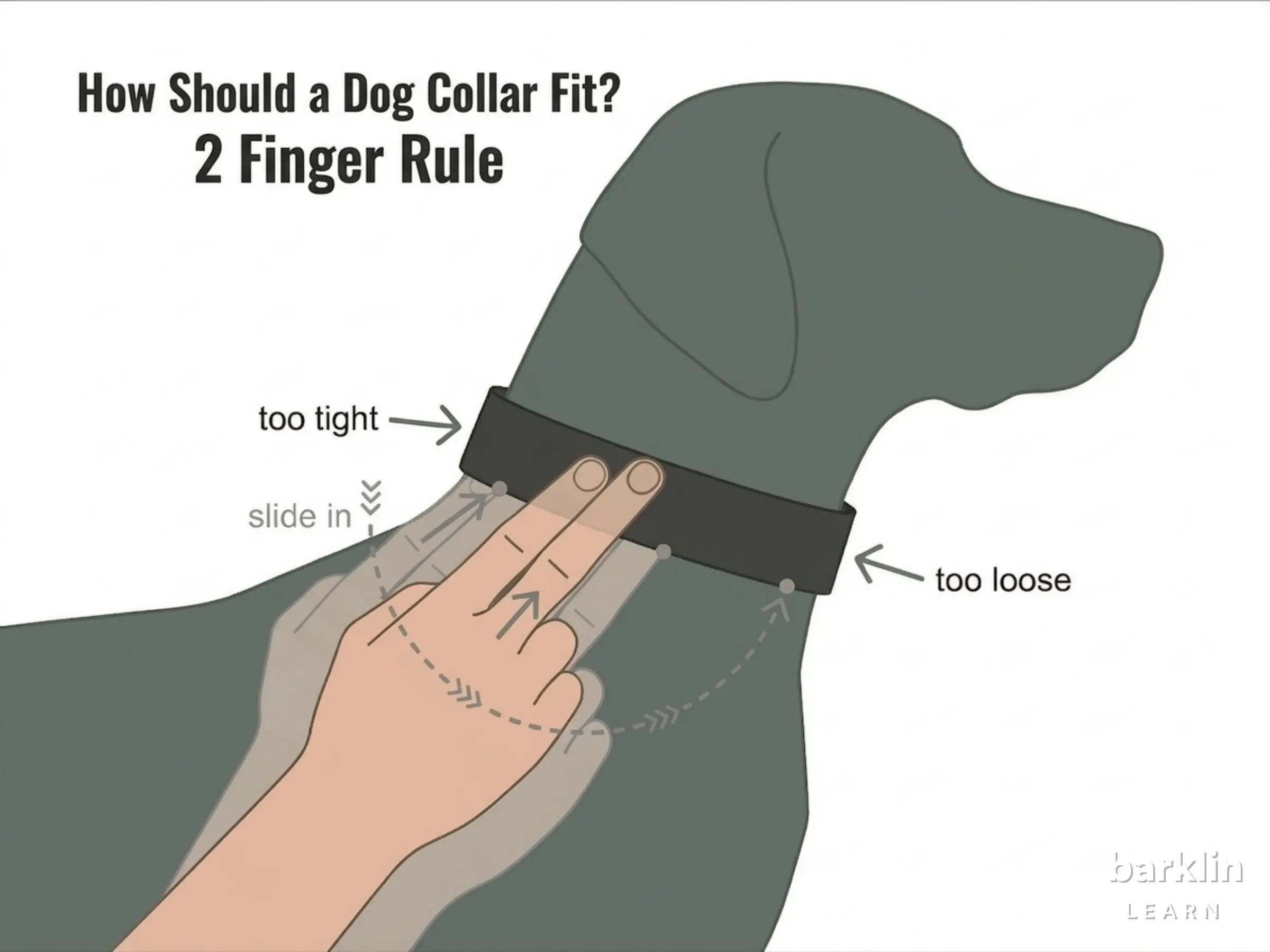
When a dog collar fits correctly
A dog collar fits correctly when it lies evenly on the neck, does not cut in, and does not slip over the head during normal movement. These are not subjective impressions — they are measurable states with clear failure signals.
Too tight: no room for two flat fingers, visible pressure on the tissue, restricted movement when swallowing. Too loose: free rotation of the band, lateral tipping, or upward migration when the dog backs up. Instability begins before the collar actually falls off. Rotation, tipping, and upward wandering indicate misfit before the collar leaves the head.
The checking logic applies regardless of body size — from the Maltese with around 9.5 cm neck circumference to the male Great Dane at more than 54 cm. The base rule stays the same. What changes are the conditions under which it is applied: coat, morphology, growth. What defines a wide dog collar structurally
A simple judgement is only reliable once the checking method itself is standardised.
How the two-finger rule is checked in practice
The two-finger rule makes the fit range measurable — but only under one condition: the dog stands calmly, neck in a neutral position, neither extended nor pulled in. Checks taken under movement or tension produce unreliable values.
Two fingers are then placed flat side by side laterally under the collar. Flat means lying in their width, not their height. A common measurement error is holding the fingers upright — that takes up more space than actually exists, and the result appears too loose.
The fingers slide laterally. The collar should not visibly lift away from the neck during this. Easy gliding without pressure is the correct signal. Visible lift-off indicates too much room.
The following table structures the fit check into measurable steps.
| Check step | What is checked | Correct result | Failure signal |
|---|---|---|---|
| Resting position | Neck neutral | No tension or evasion posture | Check taken during movement |
| Two fingers laterally | Two fingers flat | Fingers slide without pressure | Barely any room |
| Check for lift-off | Collar stays close to neck | No visible lift-off | Visible lift |
| Multi-point check | Lateral + front | Even fit throughout | Passes only at one point |
| Exception check | Coat / profile / growth | Correction applied | Rule applied without exception check |
Only when all check steps align is the fit within the functional range.
Source: Barklin FCI Breed Collar Measurement Database v2.0, March 2026.
As Diagram 2 shows, the close-up side view captures exactly this check moment: two flat fingers, no lift-off, no cut-in.

The two-finger rule controls spacing — it does not resolve breed-specific slip geometry. For dogs with an atypical neck profile, Section 4 applies.
In double-coated breeds a quantified correction applies: dense coat can distort the base measurement by 2 to 4 cm. The Barklin method applies a +3 cm correction after coat compression. Without this correction, the collar sits too loose after the next coat change.
Why the measuring position changes the fit
Nominal collar length does not determine fit. Fit depends on where and how neck circumference was measured.
The stable measurement zone is at mid-neck — not directly behind the ears and not at the neck base near the shoulders. Both are unstable measuring points: directly behind the ears, the cross-section is narrower in many breeds; at the base it is wider. Neither reflects the actual wearing position of the collar.
The Barklin formula: recommended collar length = maximum neck circumference plus 5 cm. In the male Labrador Retriever, neck circumference at mid-neck ranges from 30.8 to 31.4 cm — a difference of just 0.6 cm. A wrong measuring point shifts the result beyond that range and tips the size decision.
Small deviation, significant consequence.
If the measuring point moves upward or downward from mid-neck, then the chosen length no longer maps to the functional fit zone. If dense coat is measured uncompressed, then the result overstates the load-bearing neck circumference. These two relations determine whether a later fit check is built on reliable data.
Millimetre selection of collar width belongs to the sibling node — not here. How collar width changes pressure distribution
Source: Barklin FCI Breed Collar Measurement Database v2.0, March 2026.
How fit changes across neck profiles
The same two-finger rule gives reliable signals for a standard profile. For certain neck profiles it is structurally insufficient on its own.
Sighthounds are the most frequent and technically precise exception. The male Whippet shows an average Neck:Head Ratio of 0.72; in the male Greyhound it is 0.94 — with a neck circumference of 34 to 36 cm and a head circumference of 39 cm. Below a Neck:Head Ratio of 0.95 the slip risk rises structurally. The two-finger rule alone does not detect this geometric relationship.
Diagram 3 shows the difference in neck-head geometry: on the left the standard profile, where the head is clearly wider than the neck; on the right the sighthound profile, where neck and head width are nearly equal — the elevated slip risk is marked directly on the diagram.

The diagram describes a shape relation — not a medical or force-based claim. The geometric similarity of neck and head width is the trigger for elevated slip risk in the sighthound profile.
Brachycephalic breeds present a different structural picture: low slip risk, because head and neck are structurally similar in width. The collar remains the identification connection. Leash handling belongs on a harness — that is a question of load path, not fit.
In double-coated breeds, coat mass can distort the measurement by 2 to 4 cm. Only after coat compression and a +3 cm correction does the collar sit in the correct range. Without this correction the collar sits outside the functional zone after the next coat change.
Giant and muscle-heavy breeds bring a different variable: neck width varies more with posture and muscle tension than in compact profiles. Neutral head, mid-neck, no tension — these three conditions matter especially here. Length must be re-checked regularly, not set once and left.
The comparison table shows how the same base rule changes across neck profiles.
| Neck profile / group | Structural fit problem | Barklin rule | Practical consequence |
|---|---|---|---|
| Standard profile | Generic tightness / fit question | Two-finger rule | Base check sufficient |
| Sighthound profile | Head-neck geometric relation | Neck:Head Ratio below 0.95 | Two-finger rule alone insufficient |
| Double coat | Coat distorts measurement and fit | Compress coat + 3 cm correction | Size too loose without correction |
| Brachycephalic | Low slip risk, different leash logic | Collar for ID, leash to harness | Check fit, do not address pull here |
| Giant / muscle profile | Measuring position shifts value | Neutral head, mid-neck | Re-check length regularly |
Fit is not a single value — it is a profile-dependent checking decision.
Source: Barklin FCI Breed Collar Measurement Database v2.0, March 2026.
When you need to re-check the fit
A fit that is correct today does not hold indefinitely. Four conditions can invalidate a set value: growth, coat change, weight change, and instability signals in daily use.
For puppies the re-check interval is tightest. A Labrador puppy carries around 22 cm neck circumference at 12 weeks — a four-week re-check rhythm is recommended. A Rottweiler puppy at around 38 cm at 20 weeks follows the same schedule. For the Whippet and Saluki the interval shortens to three weeks until around 6 months, because the Neck:Head Ratio is still shifting during growth. The Great Dane puppy grows from around 30 cm at 12 weeks to over 42 cm at 24 weeks.
The calendar provides the framework. Growth rate decides.
Outside the growth phase, practical signals indicate a fit that is no longer correct: the collar tips to one side, migrates upward, leaves pressure marks in the coat, or slips when the dog backs up. In Nordic breeds with seasonal coat change, a check at the transition between summer and winter coat is due. Re-fitting in these cases means restarting with a measuring tape — not just tightening the buckle.
If the next question is how neck circumference is measured reliably and how collar size is derived from it: Continue with neck measurement and size logic
Source: Barklin FCI Breed Collar Measurement Database v2.0, March 2026.
System boundaries
This model describes the geometric fit check at the neck — pressure values, material decisions, and product-specific recommendations are outside the scope of this page.
| Topic not covered here | Further reading |
|---|---|
| Interactive size calculation | Dog collar size calculator ↗ |
| Material comparison: nylon or leather | Nylon or leather: structural comparison ↗ |