

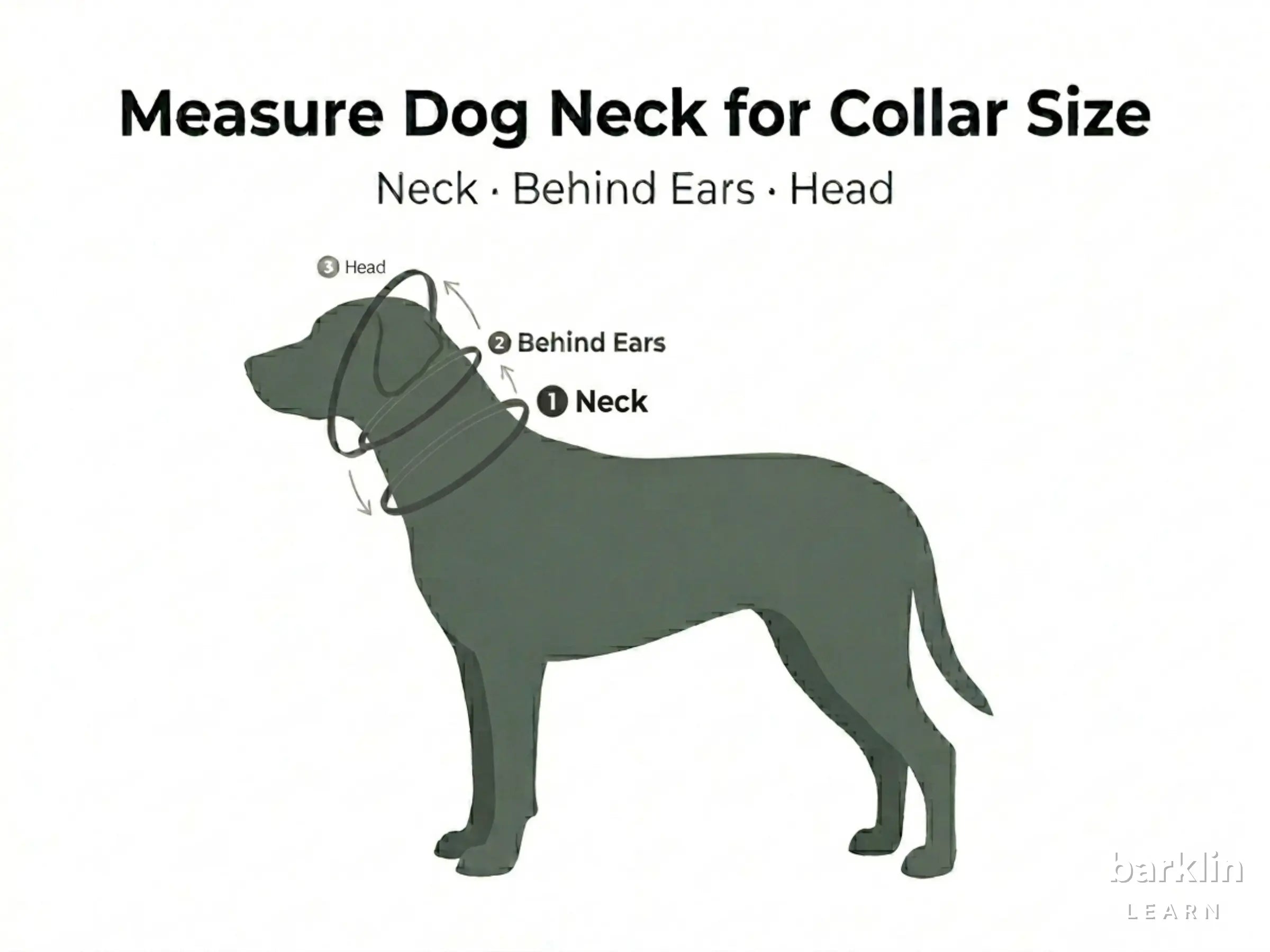
Only when the required measurement set is correct can neck circumference be meaningfully mapped to a size range.
Source: Barklin FCI Breed Collar Measurement Database v2.0, Collar Size Scale Sheet (Mosonmagyaróvár)
As diagram 2 shows, collar inner circumference and flat collar length are not interchangeable — and why using an old collar as a reference systematically produces incorrect inputs.

A collar lying flat on the table reads longer than its inner circumference in the wear circle — the material curves inward, and the difference is measurable depending on padding thickness. Measuring an old collar flat on the table and using that value as the dog's neck circumference passes the sizing system an incorrect input.
Where to measure and why the position matters
Neck circumference is measured at the planned wear position — not at the larynx, not at the shoulder. The wear position is not a recommendation; it is the geometric condition for every size comparison. Measuring in the wrong neck zone passes the sizing system a raw value that does not correspond to where the collar will actually sit.
The second measurement principle is directly linked to head circumference. If the collar system must pass over the head — or the head circumference is not clearly larger than the neck circumference — then a neck measurement alone is not sufficient. An additional head measurement becomes mandatory.
There are concrete reference values for this. The Neck:Head Ratio (NHR) describes the ratio of neck circumference to head circumference. In a male Whippet this value is 0.72, in a female Greyhound 0.92 — both breeds where a standard collar sized without a head-circumference check can be structurally over-adjusted. In a male Labrador the NHR is 1.05; here the neck measurement alone is generally sufficient for buckle collar systems. This is not a breed list. It is the logic behind the mandatory measurement set.
The measurement behind the ears — the narrowest point between the back of the ear bases and the back of the skull — is relevant for safety-sensitive systems where the collar must not pull over the head. It is the smallest measurement in this chain. If it falls significantly below the neck circumference, a tight adjustment range or a specialist model is needed.
The anatomical explanation of why these points lie exactly where they do in terms of muscle and skeletal structure does not belong in this article. Understand the anatomical measurement points on the dog's neck.
Which measurement errors distort the result
Measurements are only usable when the right object has been measured using the right method. Most sizing errors do not begin with size selection. They begin one step earlier — with the wrong reference object or incorrect allowance logic.
The following comparison does not show fit errors, but input errors that occur before size selection.
| Error type | What is measured incorrectly | Effect on sizing input | Typical trigger |
|---|---|---|---|
| Flat collar length used as reference | Length of collar lying flat instead of inner circumference | Input too high — the collar is shorter in its wear circle than the table measurement shows | Old collar used as comparison reference |
| Double allowance | Neck circumference taken with own clearance; manufacturer adds their own tolerance again | Input 2–4 cm above the raw measurement | Tape not lying flat against the coat |
| Measurement taken in wrong neck zone | Neck circumference at larynx or shoulder instead of planned wear position | Raw value does not correspond to where the collar will sit | No wear position specified before measuring |
| Head measurement missing for martingale or sighthound logic | Only neck circumference taken; head passage not checked | Incomplete measurement set; escape risk at NHR ≤ 0.92 not ruled out | Assumption that one measurement suffices for all systems |
| S/M/L selection without cm comparison | No raw measurement taken on the dog at all | Size range unknown; outcome is chance | Manufacturer size labels used as primary source without cm specifications |
Even small reference errors shift not just the number, but often the entire measurement set passed to the table or simulator.
How a raw measurement becomes a reliable sizing input
A neck circumference is a raw measurement. No sizing system processes it directly into a size. Between the raw measurement and the correct collar size there is at least one classification step.
That step is classification by collar system. Someone buying a buckle collar passes the raw measurement to a size table with discrete ranges. Someone choosing a martingale model passes two measurements. Someone choosing a slip-stop collar for a sighthound passes three. The raw measurement stays the same; the measurement set changes.
As diagram 3 shows, the measurement position on the neck changes the raw value — upper neck, mid-neck, and lower neck produce different circumference values that are not interchangeable.

Measuring at the wrong position passes the sizing system a raw value that does not correspond to where the collar will sit — the measurement set starts in the wrong place.
The following overview separates body measurements from product measurements and assigns them to the collar system.
| Measurement | What it is | Who can take it | For which collar type | Common error |
|---|---|---|---|---|
| Neck circumference | Body measurement, wear position | Measurable with tape alone | All systems | Wrong zone or taken with allowance added |
| Collar inner circumference | Product measurement — closed collar measured from inside | Existing collar or manufacturer specification | Adjustable models, plausibility check | Incorrectly equated with neck circumference |
| Head circumference | Body measurement — widest point across the ears | Measurable with tape alone | Martingale / slip-stop | Not taken because neck measurement seemed sufficient |
| Behind the ears | Body measurement — narrowest safety-zone point | Measurable with tape alone | Critical escape profile / tight adjustment range | Often unknown, skipped |
Only body measurements are taken on the dog; product measurements come from manufacturer specifications or from re-measuring existing collars.
The conversion chain runs: raw measurement on the dog → classification by collar system → take any additional measurements if required → pass the complete measurement set to the size table or simulator. Each step is separable. How measurement data then translates into a sensible collar width is described in a separate article: How measurement data translates into a sensible collar width. Size values can then be checked directly: Check the measurement values in the Barklin sizing simulator.
When the measurement set is complete, the next step is not width selection but fit verification: How to check whether the collar fits correctly later.
System boundaries
This model covers body measurements as sizing inputs only — fit logic, width reasoning, anatomical depth, and individual size recommendation are handled in separate nodes.
How a collar should fit on a dog is outside the scope of this article. That question belongs to a separate fit-verification node.
Which collar width makes sense is also outside the scope here. Width reasoning belongs to a separate width-logic node.
Why certain measurement points are anatomically relevant is not explained in depth in this article. That belongs to a separate anatomy node.
A specific size recommendation for an individual dog is not part of this model. That step belongs in the Barklin sizing simulator.