

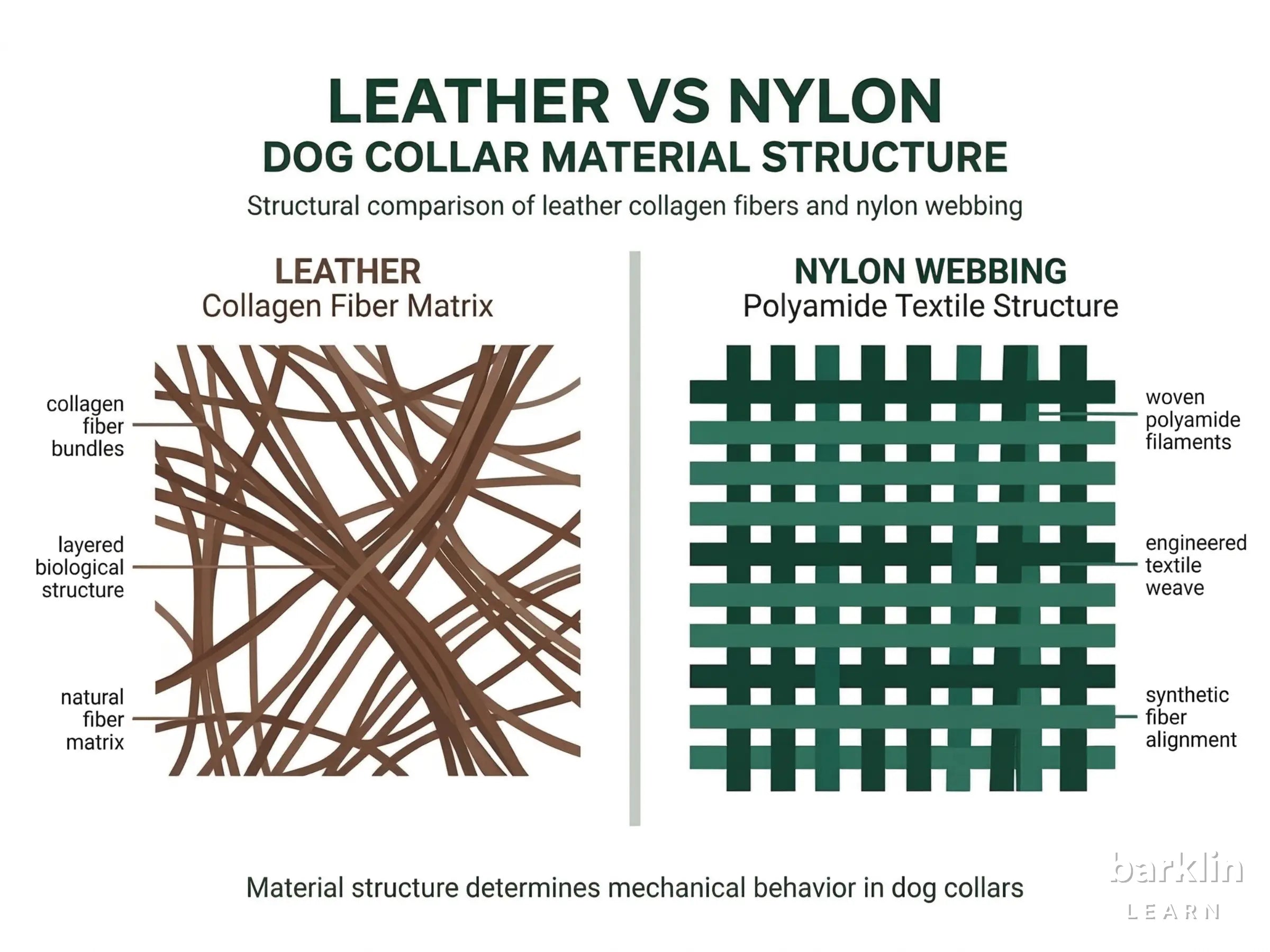
How leather and nylon are built as collar materials
Leather and nylon are not two variants of the same collar material; they belong to structurally different material classes. Leather is a biological product: collagen fibers layered into a dense, planar matrix through a natural binding network. Those fibers run irregularly — orientation and density vary by animal species, body area, and tanning method. Surface density and cross-sectional profile differ even within a single piece.
Nylon webbing is the opposite: an orthogonally woven filament network of synthetic polyamide, where warp and weft threads are arranged at defined crossing angles. The filaments are chemically specified, geometrically uniform, and mechanically predictable. What one piece of nylon webbing does under tensile load, the next piece of the same specification will do in the same way.
This fundamental difference explains why comparing the two materials cannot stop at tradition or appearance. To understand why a 40 mm leather strip and a 40 mm nylon band respond differently under load and moisture, you first need to examine what happens at the fiber architecture level. The structural difference is the subject here, not a buying guide.
For an overview of the polyamide material class behind nylon webbing, see Regenerated nylon: what the term means for dog collars.
Which material data make the difference measurable
The structural differences show up in measurable material values. Tensile strength is the most important baseline figure: it indicates how much stress a material withstands under tensile load before plastic deformation begins. Nylon webbing reaches values between 50 and 90 MPa, a direct result of the dense polyamide filament weave and the chemically stable polymer bonds. Leather sits at 15 to 35 MPa. The difference is not a quality judgment; it is a structurally determined outcome: collagen fibers grew biomechanically and were not engineered for textile tensile loads.
Elongation behaviour follows the same pattern. Nylon webbing stretches uniformly under load and returns largely to its original shape after unloading, with a fracture point at 15–30% elongation. Leather reaches fracture at 25–50% elongation, but takes on plastic deformation earlier: collagen fibers partly reorient under sustained load, which can result in irreversible length increase. This is not a material defect. It is the known break-in characteristic of the material.
Moisture absorption is the third parameter. Nylon webbing absorbs less than 4% of its own weight. Leather absorbs up to 50%. That figure changes not only the weight of the collar, but the mechanical properties themselves.
This table makes the structural differences between leather and nylon measurable at the material level.
| Property | Nylon webbing | Leather |
|---|---|---|
| Base structure | Woven polyamide textile (synthetic) | Collagen fiber matrix (biological) |
| Fiber architecture | Orthogonal filament weave, uniform | Biological fiber bundles, irregularly oriented |
| Tensile strength | 50–90 MPa | 15–35 MPa |
| Elongation at break | 15–30% | 25–50% |
| Moisture absorption | < 4% | 30–50% (up to own weight) |
| Abrasion resistance | High (synthetic polymer) | Medium to high (depends on tanning) |
| UV resistance | High | Medium (without conditioning: degradation possible) |
These baseline values explain why both materials respond differently under tensile load, moisture, and increasing width.
Source: Barklin Material Mechanics Dataset & Width Interaction Analysis v1.0. Nylon webbing tensile strength: 50–90 MPa; leather: 15–35 MPa.
As shown in Diagram 2, leather and nylon diverge in their elongation behaviour from the outset: the collagen structure of leather responds earlier and reaches a lower elongation plateau, while the textile fiber composite of nylon shows a longer, more gradual elongation range.

This divergence in elongation behaviour means that nylon webbing yields more uniformly under tensile load and returns to shape more consistently, while leather changes its geometry more permanently when load is repeated or sustained.
For context on recycled textile input families used in the Barklin material system, see REPREVE® in dog collars – material properties and construction.
How structure determines tensile behaviour
Fiber architecture is not a visual property; it determines how a collar responds under load. If the material is built as a uniform polyamide weave, then contact conformity at 40 mm width is immediate and consistent. If it is built as a collagen fiber matrix, then bending stiffness increases disproportionately with width, and contact conformity depends on the break-in state and moisture condition.
Nylon webbing has approximately linear bending stiffness: the wider the band, the more filaments contribute in parallel to load bearing, and stiffness increase stays proportional to width increase. Leather, as a biological composite, exhibits non-linear bending characteristics. With increasing width and corresponding material thickness, bending stiffness rises disproportionately. A 40 mm leather strip is structurally far stiffer than three times the value of a 13 mm strip would suggest.
Add to this the tensile strength ratio: nylon at 50–90 MPa, leather at 15–35 MPa. Under the same tensile impulse, nylon undergoes significantly less plastic deformation. Nylon webbing maintains its geometric shape across width variations immediately, with no break-in phase.
Width does not change which material is stiffer. It amplifies the structural gap.
Moisture entry changes both systems, but in structurally different ways. Nylon webbing absorbs less than 4% moisture; the filament structure remains largely stable and the mechanical properties change minimally. Leather absorbs up to 50% of its own weight in water. The collagen fibers swell, fiber bundle orientation partially shifts, and bending stiffness changes depending on whether the leather is dry, wet, or cycling between both states.
As shown in Diagram 4, moisture absorption and mechanical response follow fundamentally different paths in leather and nylon: leather shows a broad absorption curve with structural consequences, while nylon remains comparatively stable across the moisture range.

Absorbed water changes mechanical behaviour differently in collagen matrix than in polymer weave. In leather, a combination of swelling, fiber reorientation, and stiffness change occurs. In nylon, the filament geometry remains more stable.
How the difference changes at 40 mm width
Width is not a neutral factor. Both materials respond to the increase from 20 mm to 40 mm in structurally different ways. The difference in bending stiffness, which is smaller at narrow widths, amplifies with increasing width, driven by structure rather than processing quality.
In nylon webbing, flexibility does not diminish markedly as width increases: the orthogonal filament arrangement keeps the weave pliable, and contact conformity with the neck occurs immediately. In leather, bending stiffness at 40 mm is already a structurally different state compared with 20 mm, particularly with new, not-yet-broken-in material. This difference is not a sign of inferior quality; it is the direct result of fiber architecture.
This comparison table shows how 40 mm width produces mechanically different outcomes depending on material.
| 40 mm scenario | Mechanical consequence | Condition |
|---|---|---|
| Nylon — high flexibility | Uniform contact conformity at the neck | Immediate, no break-in required |
| Leather — higher bending stiffness | Reduced initial conformity, uneven contact | New, still stiff material |
| Leather — shape adaptation after break-in | More uniform contact surface | After sufficient break-in phase |
| Nylon wet — altered use behaviour | Normalises on drying; structure remains stable | After drying |
| Leather wet/dry cycling — stronger structural change | Bending stiffness increases; material response is amplified | Without regular conditioning |
What matters is not width alone, but how the material carries that width under real bending and moisture conditions. Width amplifies the structurally determined differences; it does not cancel them out.
What the material difference means in practice for wide collars
A wide collar does not distribute contact evenly across the neck simply because the width is the same. Whether a 40 mm collar distributes the contact surface more uniformly depends on how well the material conforms to the neck geometry, and that in turn is a function of the material's bending stiffness and moisture response.
Nylon webbing, through its lower bending stiffness, conforms immediately to the neck cross-section. The contact band lies more evenly against the neck with no break-in phase required. Leather at 40 mm behaves differently: new, stiff leather initially rests on more limited contact zones rather than over a more uniform surface. Only after the break-in phase does the contact band conform more fully.
As shown in Diagram 3, it is not only width but also material structure that determines contact geometry at the neck: nylon produces a more uniform contact surface at 40 mm than leather does in new condition.

Identical width can produce different contact geometry, depending on which material is transmitting the bend at the neck and what state it is in.
The structural background to these differences is explored further in the pressure distribution analysis: Understand pressure distribution in dog collars.
System boundaries
This model describes material structure and mechanical behaviour of nylon webbing and leather at the material capability level, not behaviour on an individual dog under specific use conditions.
| Out of scope | Further reading |
|---|---|
| Determining exact collar width for an individual dog | Measuring your dog's neck circumference |
| Comparing recycled textile material families | rPET in dog collars – material properties and structure |