

What determines dog collar width
This guide walks through five steps to the correct collar width and length for your dog. You need two inputs: the dog's current body weight and the measured max neck circumference. Both feed into separate calculations.
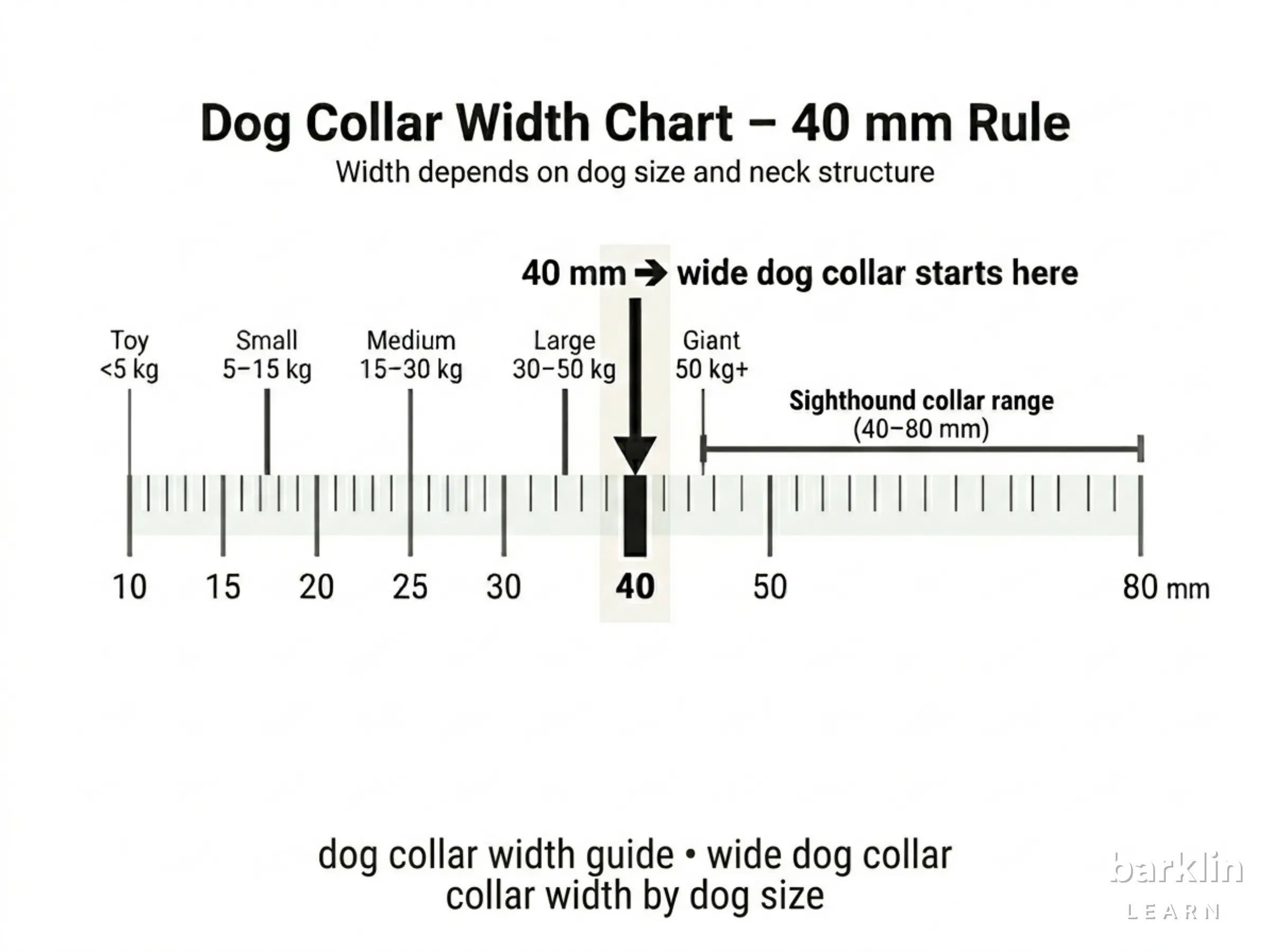
The width decision follows a two-stage logic. Stage 1: body weight sets the starting value — 10 mm to 50 mm by weight class, per the Barklin FCI Breed Collar Measurement Database v2.0. Stage 2: breed anatomy determines whether that starting value holds, or whether a correction factor replaces it.
For most dogs: look up the weight, take the value, done. The correction factors apply to four clearly defined breed groups. The clearest example is the Whippet: a male weighs typically 12–14 kg, weight table would give 15–20 mm. His Neck:Head Ratio is 0.72 (neck circumference 22.6–24.5 cm, head 34 cm). That sits below the 0.95 threshold, which overrides the table entirely. Result: 40–80 mm taper.
The Rottweiler is a different case. His weight already lands in the wide-collar range. What anatomy corrects here is not the width result — it is the measurement method. Step 2 must be done with the head in neutral position. A lowered head posture during measurement skews the neck circumference and therefore the length result in Step 5.
The 40 mm threshold
Before starting Step 1, you need a reference point: the 40 mm threshold. In the Barklin system it marks the boundary between narrow-to-medium and wide dog collars. In Step 4 you will position your width result against this value.
The threshold is a technical working definition — not an FCI standard and not a veterinary guideline. It functions as a classification boundary, not an effect claim. Two routes lead above it: via weight, dogs above 30 kg land in the 30–40 mm zone; above 50 kg directly at 40–50 mm. Via geometry, sighthounds with NHR below 0.95 always land at ≥ 40 mm regardless of body weight.
The table below is your reference for Step 1. Look up the starting value for width and keep the result.
| Weight class | Starting width (mm) |
|---|---|
| under 5 kg | 10 mm |
| 5–15 kg | 15–20 mm |
| 15–30 kg | 25 mm |
| 30–50 kg | 30–40 mm |
| 50 kg and above | 40–50 mm |
From the 30–50 kg zone onward, the weight table already touches the 40 mm threshold.
According to the Barklin FCI Breed Collar Measurement Database (v2.0, March 2026)
Diagram 2 shows the collar length formula and the Barklin size scale — you will need both in Step 5.

The scale shows where the 40 mm threshold sits within the size classes: sizes M and L are the transition zones where anatomical corrections can change the width decision — the length formula in Step 5 stays identical for every breed.
Width selection step by step
Step 1: Body weight as starting value. Determine the dog's current body weight. Look up the starting value in the reference table in Section 2: under 5 kg = 10 mm; 5–15 kg = 15–20 mm; 15–30 kg = 25 mm; 30–50 kg = 30–40 mm; 50 kg and above = 40–50 mm. Note the result.
Step 2: Capture max neck circumference. Note the maximum measured neck circumference — it will be used in Step 5 for the length calculation. The measurement method itself (tape positioning, coat correction, head posture) is covered in How to measure neck circumference correctly. This step uses only the result. Double-coated breed: note +3 cm here — it comes into play in Step 5.
Step 3: Check the anatomical correction factor. Does your breed fall into one of the four categories? Sighthound with NHR below 0.95: the Step 1 starting value is discarded, result is 40–80 mm taper. Brachycephalic (NHR ≥ 1.0): collar as ID carrier only, no leash use via this collar. Double-coated breed: Step 1 starting value holds for width; the +3 cm from Step 2 feeds into Step 5. Giant or muscle breed: starting value holds, but the Step 2 measurement must have been taken with head in neutral position.
Step 4: Position result against the 40 mm threshold. Below 40 mm: narrow to medium-width collar. At or above 40 mm: wide dog collar by Barklin definition. Sighthounds with NHR below 0.95 always land at ≥ 40 mm regardless of body weight. The verification basis for each breed group is in the next section.
Step 5: Calculate collar length. Formula: max neck circumference + 5 cm = collar length. Match the result to the Barklin size scale (XS–XXXL). Full execution is in Section 5, including the size table.
Width logic by breed group — quick reference
| Group | Correction factor | Width range | Decision focus |
|---|---|---|---|
| Standard breeds | Weight table applies | 10–40 mm | Weight as sole factor |
| Sighthounds | NHR < 0.95 → table overridden | 40–80 mm taper | Check Neck:Head Ratio |
| Brachycephalic | NHR ≥ 1.0 → ID carrier only | by weight (usually 15–25 mm) | Resolve leash guidance externally |
| Giant/muscle breeds | Width confirmed, measurement method corrected | 40–50 mm | Neutral position when measuring |
Anatomical correction factors by breed group
Step 3 of this guide asks whether an anatomical correction factor applies to your breed. This section provides the verification basis for each of the four groups. If your breed is not listed, the Step 1 starting value applies without correction.
Sighthounds
In the Barklin dataset, Whippet and Greyhound are the reference cases. Male Whippet: neck 22.6–24.5 cm, head 34 cm, NHR: 0.72. Male Greyhound: neck 34.1–36.5 cm, head 39 cm, NHR: 0.94. Both fall below the 0.95 threshold. Result in both cases: 40–80 mm taper, Step 1 starting value discarded.
Whether your dog qualifies as a sighthound below NHR 0.95 is a question of geometry, not weight. For the full geometry model, see Sighthound neck geometry in detail.
Brachycephalic breeds
French Bulldog and Pug reach NHR values of 1.13 and above. The ratio is inverted: the neck is wider than the head. The collar functions as an ID carrier only. Leash guidance questions fall outside this guide.
Double-coated breeds
Husky, Chow Chow, Samoyed: the Step 1 starting value holds for the width decision unchanged. The +3 cm coat correction you noted in Step 2 feeds only into the length calculation in Step 5.
Giant and muscle breeds
Great Dane, Kangal, Rottweiler, Boerboel: the 50 kg+ weight class places these breeds directly at 40–50 mm. Anatomy does not change the width result. It requires that Step 2 was executed correctly: measurement with the head in neutral position, no lowered posture during measuring.
The table assigns each breed group to its correction factor and the resulting width class.
| Breed group | Correction factor | Width outcome |
|---|---|---|
| Sighthounds | NHR < 0.95 → weight table overridden | 40–80 mm taper (always) |
| Brachycephalic | NHR ≥ 1.0 → ID carrier only | by weight (usually 15–25 mm) |
| Double-coated breeds | +3 cm measurement addition to length | by weight (width unchanged) |
| Giant/muscle breeds | Measurement method corrected (neutral position) | 40–50 mm |
Only for sighthounds is the weight table completely overridden; for all other groups it remains the base.
Diagram 3 shows the anatomical width comparison across three neck profiles side by side.

The comparison reveals that standard and giant breeds scale by body weight while sighthounds scale by neck geometry only. For Step 3, that is the key distinction: which scaling path applies to your dog?
How to calculate collar length
Once width is settled, the final calculation follows. Formula: max neck circumference + 5 cm = collar length. The +5 cm is a technical tolerance buffer for measurement variation and movement range — not a clinical safety margin, and not a substitute for a fit check.
Working example: male Labrador, max neck circumference 44 cm. Calculation: 44 + 5 = 49 cm. That falls just under size M (50 cm collar length). The dog is placed in size M, which provides 1 cm downward margin.
Three common errors in Step 5. First: forgetting the double-coated correction. If you noted +3 cm in Step 2, it applies here: use max neck circumference + 3 cm as the base before adding 5 cm. Second: using a measurement taken with the head lowered. That reading is too large; repeat Step 2 with the head in neutral position. Third: confusing width and length. Width comes from Steps 1 and 3. Length comes from this formula. They are independent.
The size table translates the measured neck circumference into a collar length and a Barklin size class.
| Size | Neck min (cm) | Neck max (cm) | Collar length (cm) | Typical breeds |
|---|---|---|---|---|
| XS | 18 | 26 | 31 | Chihuahua, Yorkshire Terrier, Toy Poodle, Maltese |
| S | 26 | 35 | 40 | Dachshund Std, Beagle, Jack Russell, French Bulldog, Whippet |
| M | 35 | 45 | 50 | Labrador F, Golden F, Border Collie, Weimaraner, Vizsla, Malinois |
| L | 45 | 55 | 60 | Labrador M, Golden M, Dobermann F, German Shepherd, Greyhound |
| XL | 55 | 65 | 70 | Dobermann M, Rottweiler, Cane Corso, Bullmastiff, Alaskan Malamute |
| XXL | 65 | 80 | 85 | Great Dane, Saint Bernard, Leonberger, Kangal, Newfoundland |
| XXXL | 80 | 120 | 125 | Largest Saint Bernard / Kangal individuals |
If you want to verify the result on the dog, the next step is Fit check: how a collar should sit.
The formula produces a technical length recommendation — not a fit guarantee.
The Barklin sizing tool runs the full calculation interactively: Calculate your size interactively.
System boundaries
This guide defines dog collar width and collar length based on body weight, breed anatomy, and maximum neck circumference. It does not cover pressure mechanics or the formal definition of wide collars beyond this calculation model.
| Not covered here | Further reading |
|---|---|
| Pressure distribution (kPa / Newton) | Pressure distribution explained |
| Definition of a wide dog collar | What counts as a wide collar |