

Why the neck profile of sighthounds must be read differently
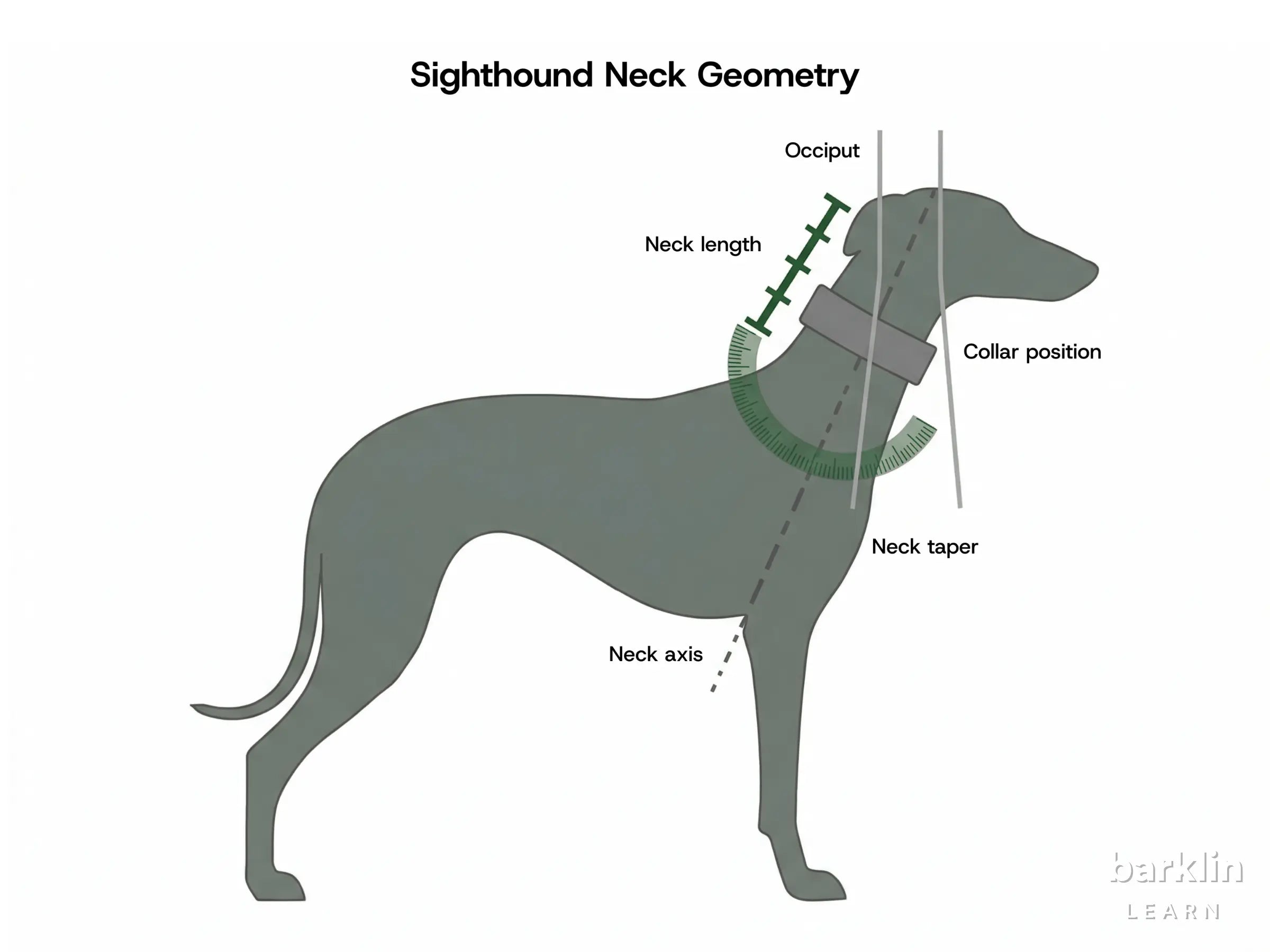
In German cynology the term Windhund refers to FCI Group 10 — a group of breeds sharing a visual hunting method and similar neck geometry. Many of these breeds show a long, slender neck with a visible taper from the shoulder transition toward the occiput. For geometric width analysis, this produces a clear consequence: not every neck circumference answers the same question.
In the simplified geometry model, this shape difference is expressed through two circumferences. Cmax describes the maximum neck circumference near the shoulder. Ccoll describes the circumference at the collar position in the upper neck zone. The ratio TRc = Cmax / Ccoll describes the geometric shape difference between these two zones — not safety or fit as an absolute claim. In the primary set TRc ranges from 1.12 to 1.23; in the control group from 1.04 to 1.09 (Barklin Sighthound Neck Geometry Workspace, March 2026).
FCI standards describe sighthound necks in qualitative terms — long, dry, elegantly carried. That level alone is not sufficient for a geometric width analysis. This article combines breed-type description with the simplified geometry model and position-based reference values from the Barklin Sighthound Neck Geometry Workspace (March 2026). For broader anatomical context see dog neck anatomy overview. For the wider cluster context behind this node, see the system guide.
Which proportions shape neck geometry
Alongside taper, the ratio of neck length to withers height (NWR) describes a further structural property. In the Barklin reference frame, NWR for many sighthound breeds falls between 0.34 and 0.45, while the control group falls predominantly between 0.30 and 0.33. This distribution describes a directional shift, not a hard anatomical boundary (Barklin Sighthound Neck Geometry Workspace, March 2026).
The comparison diagram uses Greyhound (NWR 0.40), Whippet (0.43) and Azawakh (0.35) as primary examples against Labrador Retriever (0.30) as the control. Two edge cases illustrate the parameter’s limits: the Azawakh sits at 0.35 at the lower boundary of the sighthound zone but shows one of the strongest taper values in the primary set. The Border Collie reaches a similar NWR value, but not the same collar-position geometry. NWR must therefore always be read together with TRc and Ccoll.

As Diagram 2 shows, neck-length proportion helps separate the long-neck profile from the control group, but it does not replace taper analysis. It adds proportional context to the collar-position model rather than deciding width on its own.
Where collar position becomes geometrically relevant in sighthounds
For the geometry model the relevant starting point is not the lower neck but the position in the upper neck segment below the occiput. In this zone many sighthounds are narrower than near the shoulder transition. That is why Ccoll is defined as its own circumference value: it describes the neck circumference at the point where the collar is geometrically read.
The following table shows how much circumference is lost between the maximum neck zone and the collar-position zone in the same simplified model (Barklin Sighthound Neck Geometry Workspace, March 2026).
| Breed | Cmax (cm) | Ccoll (cm) | Difference |
|---|---|---|---|
| Saluki | 34.5 | 28.0 | 6.5 cm |
| Galgo Español | 34.0 | 28.5 | 5.5 cm |
| Azawakh | 30.0 | 24.5 | 5.5 cm |
| Whippet | 31.0 | 26.0 | 5.0 cm |
| Greyhound | 38.0 | 34.0 | 4.0 cm |
The table shows that collar-position circumference is consistently smaller than the maximum neck circumference in the primary set. That is why the upper-neck zone must be measured as its own geometric reference point.
How width, circumference, and contact angle work together
The simplified contact-area model uses A = (w · Ccoll · θ) / 360. w is band width, Ccoll is circumference at the collar position, θ is the contact angle. This article uses 4 cm width and 144° throughout to keep breed comparisons directly comparable (Barklin Sighthound Neck Geometry Workspace, March 2026).
The following comparison table keeps width and angle fixed so that only the collar-position circumference changes the modeled contact area across breeds.
| Breed | Ccoll (cm) | Width | Angle | Contact area |
|---|---|---|---|---|
| Greyhound | 34.0 | 4 cm | 144° | 54.4 cm² |
| Galgo Español | 28.5 | 4 cm | 144° | 45.6 cm² |
| Saluki | 28.0 | 4 cm | 144° | 44.8 cm² |
| Whippet | 26.0 | 4 cm | 144° | 41.6 cm² |
| Azawakh | 24.5 | 4 cm | 144° | 39.2 cm² |
The table shows that the geometric contact area rises or falls with Ccoll when width and angle stay fixed. For the mechanism layer see pressure distribution in dog collars.
What neck taper means for a 4 cm collar
A 4 cm collar is not relevant in sighthounds because 4 cm is abstractly wide. It becomes relevant only in combination with the Ccoll value in the tapered neck segment. When the position-based circumference is clearly smaller than the maximum circumference, the same width covers a proportionally larger share of the contact band than it would on a more evenly shaped neck.
The primary set shows two different taper parameters. TRc (Cmax/Ccoll) describes the collar-referenced difference — values from 1.12 in Greyhound to 1.23 in Saluki. The taper ratio by head and neck width describes the physical shape geometry — values from 1.11 in Greyhound, Galgo Español, and Saluki to 1.19 in Azawakh. Control values stay below that range. The Azawakh shows one of the strongest taper readings in the primary set, which changes how a 4 cm band is geometrically read in the upper-neck zone (Barklin Sighthound Neck Geometry Workspace, March 2026).

As Diagram 3 shows, taper changes two things at once: the collar position moves upward into a narrower segment, and the same 4 cm band occupies a larger share of the usable upper-neck contact band than it does on a more even profile.
This model does not claim that a wider collar prevents injury or is suitable for all sighthounds. It describes only how neck taper and collar position change the geometric reading of a 4 cm band. For individual measurement, see measure neck circumference at the collar position.
Once the collar-position circumference is known, you can choose a suitable model from the wide dog collar collection.
System boundaries
This model describes a simplified geometric reference frame rather than a measured pressure zone under live use.

| Out of scope | Further reading |
|---|---|
| Individual size choice for a specific dog | Measure neck circumference at the collar position |
| Collar versus harness as a decision framework | Collar or harness comparison |